Piantini's Sidewalks Are Finally Catching Up to Its Skyline
September 17, 2026
September 17, 2026
Anyone who has lived in Piantini for more than a year knows the neighborhood's real geography isn't the grid of avenidas on a map. It's a private shuttle between parking structures: Agora Mall to Blue Mall to a restaurant valet stand and back to a building garage, rarely on foot, rarely by accident. Piantini built vertically for two decades while its ground floor stayed exactly what it had always been, a strip of curb cuts and driveways connecting one air-conditioned box to the next.
That's the part that's changing now, and it's changing from the street up rather than the skyline down.
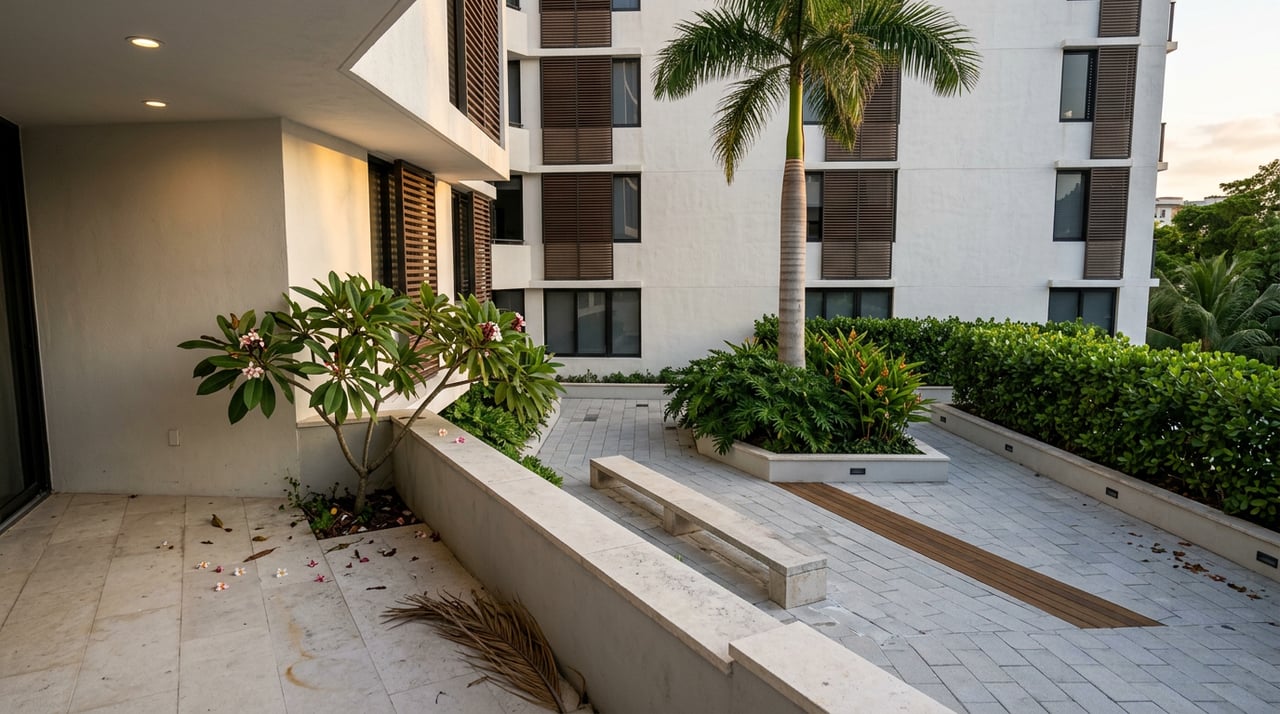
In May 2026, developer Grupo GHR unveiled a sculpture by artist Fernando Varela called Diálogos in a new public plaza at the base of its Parkside tower, on the corner of Federico Geraldino and David Ben Gurion. The piece is designed to read differently depending on where you stand around it, which is a fitting detail for a project that's less about the tower above it than the sidewalk in front of it.
Parkside ceded 32 percent of its buildable land to the city as public space and widened the adjacent sidewalks to seven meters, well beyond what Piantini's older blocks offer pedestrians. The plaza's social areas were handed over already furnished and climate controlled, ready for residents and neighbors to use immediately rather than waiting on a future phase. Grupo GHR has framed the project explicitly as a contribution to Piantini's walkability, not just another residential delivery. The tower itself isn't scheduled to hand over units until December 2026, but the plaza and the sculpture are already open and already being used, which means the public half of the project arrived a full season before the private half.
That sequencing matters more than it looks. Piantini has plenty of buildings with lobbies and gyms reserved for residents only. It has almost no public seating that isn't attached to a restaurant tab. A plazoleta with a permanent art installation, open to anyone walking past on Ben Gurion, is a different kind of amenity than the ones this neighborhood is used to counting.
The clearest evidence that people are actually using Piantini's sidewalks rather than just driving between destinations is what's happened on the short stretch of blocks around La Cassina. La Cassina has spent years earning its reputation as the top table in the country, built on modern Mediterranean cooking, an extensive cellar with both Spanish and international bottles, and live music on Thursday nights. Upstairs, Room 504 runs as the city's most talked-about club, with international resident DJs working Thursday through Sunday.
What's newer is Casa Luca, opened by the same team a short walk from the original restaurant. It's a deliberately more casual room, tropical chic in its decor with a hand-painted mural, and a Mediterranean menu designed by Chef Cristobal Martos. The decision to build a second, more relaxed address instead of simply expanding the first one is a bet that people in this neighborhood want to walk between two different moods on the same night rather than commit to one for the whole evening.
That same logic shows up a few blocks over. Casa Brava has been serving Spanish cuisine since 2003, now run by three generations of the same family: Vicente Soto Ron, his son Vicente Soto Ricart, and Joan González Ricart. SBG, a few doors down, plays a different register entirely, an international raw bar with a design sensibility its own team describes as Hamptons-inspired, built around oysters, rice, and a wine list that runs deep into Ribera del Duero and Rioja alongside its international selections.
None of this is new in the sense of "restaurant opened this year." What's new is the density of it within walking distance, and the fact that Piantini's older landmark, El Mesón de la Cava, sits at the far end of the same conversation. Built inside a natural limestone cave and operating since 1967, it's been written up by the New York Times as one of the Caribbean's more distinctive dining rooms. It was doing this decades before Piantini had a cluster of newer rooms to be compared against. The neighborhood now has both an anchor and a rotation, which is a different thing than having just an anchor.
The Santo Domingo Marriott Hotel Piantini opened in March 2024 on Avenida Abraham Lincoln at Andrés Julio Aybar, and most residents still think of it as a business hotel rather than a place they'd choose to eat. That's worth reconsidering. The property runs four distinct restaurants under one roof: Mo'orea for all-day Mediterranean dining, Cueva Siete for Mexican, Makoto for Asian fusion, and Leyla for Lebanese, plus a lobby bar for anyone who just wants a drink without committing to a meal. The 21st floor holds a rooftop pool with views that stretch to both the mountains and the Caribbean Sea, open in a way that most condo rooftop pools in the neighborhood are not.
Hotel restaurants rarely register as neighborhood dining options because they're marketed to guests rather than to the people who live three blocks away. But a four-restaurant lineup with a rooftop bar sitting in the middle of Piantini is a genuine addition to the neighborhood's evening options, whether or not anyone's booked a room there. It's the kind of amenity that shows up in the annual sameness of local Google reviews long before it shows up in how residents actually talk about where to go on a Tuesday night.
Not every signal is a sculpture or a four-restaurant hotel. Sometimes it's a coffee shop moving two blocks and posting about it. DBL Market recently relocated within Piantini, to Calle Interior Oeste #12, and the message accompanying the move made a point of noting the new spot is still close to the old one. That's a small thing, but it's a telling one. A business that could have chased cheaper rent farther out chose instead to stay inside the same walkable radius its regulars already knew, on the theory that proximity to foot traffic is worth more than square footage.
That's the same theory Grupo GHR is betting on with Parkside's plaza, and the same one La Cassina's ownership is betting on by opening Casa Luca within walking distance rather than across town. Piantini's businesses are increasingly clustering rather than spreading out, which is a different growth pattern than the mall-anchored sprawl the neighborhood built its first identity around.
None of these developments individually rewrites what Piantini is. A sculpture in a plaza, a second restaurant from an established kitchen, a hotel's dining room, a coffee shop's short move down the block, taken alone, each reads as background noise. Taken together, they describe a neighborhood quietly shifting its center of gravity from the mall parking structure to the sidewalk in front of it. A few years ago, Piantini had none of this: no plazoleta with public art, no four-restaurant hotel dining scene inside its own boundaries, no second address from La Cassina's team, no coffee shop willing to bet that walking distance matters more than a bigger storefront somewhere else. Each arrived on its own timeline, but all four now sit within the same few blocks.
Parkside's residential units won't hand over until December 2026, but its public plaza is already doing the work the tower was designed to support. That's usually backwards for a development project. Here, it might be the most accurate description of where Piantini is right now: the private inventory is still being built, but the public life of the neighborhood is already a season ahead of it.
If you're watching how a neighborhood like Piantini evolves and want a read on what that means for property here, Auburn Lucas tracks these shifts as part of daily practice in the market. Reach out to receive exclusive listings and a grounded read on where Santo Domingo's most closely watched district is headed next.
Stay up to date on the latest real estate trends.
We pride ourselves in providing personalized solutions that bring our clients closer to their dream properties and enhance their long-term wealth.
Your Dominican Republic Connection
Contact Us
Centro Corporativo Capital Segundo Piso
Calle Altagracia La Romana Dominican Republic 22000